If you have ever had a block paved driveway or patio pressure washed, you have probably noticed something once the surface dries: the joints between the blocks look emptier than before. That thin line of sand that used to sit snugly between each block has thinned out, and in some spots it may have disappeared completely.
This is one of the most common questions we hear from homeowners across Bournemouth, Poole, Christchurch, and Ringwood. Is this normal? Is it a sign the job was done badly? And what actually happens to that sand?
In this guide, we will explain exactly why block paving loses sand during pressure washing, whether it is something to worry about, and what needs to happen afterwards to keep your driveway stable and looking its best.
What Jointing Sand Actually Does
Block paving is not laid like a patio slab and cemented into place. Instead, individual blocks are laid on a compacted base, and the narrow gaps between them are filled with kiln dried jointing sand.
This sand is not there for appearance. It performs a genuinely structural job:
- It locks each block against its neighbours so they cannot shift sideways
- It spreads the weight of vehicles and foot traffic evenly across the whole surface
- It stops water from washing straight down into the sub base
- It fills the space that would otherwise be an open gap for weeds and moss to colonise
Without sand in the joints, block paving is essentially a loose jigsaw of individual pieces sitting next to one another with nothing holding them together. That is why the condition of the jointing sand matters just as much as the cleanliness of the surface itself.
Why Does Block Paving Lose Sand After Pressure Washing?
Now to the main question. There are several reasons why pressure washing removes some of the sand from between your blocks, and usually it is a combination of these factors rather than just one.
1. Water Pressure Forces Sand Out of the Joints
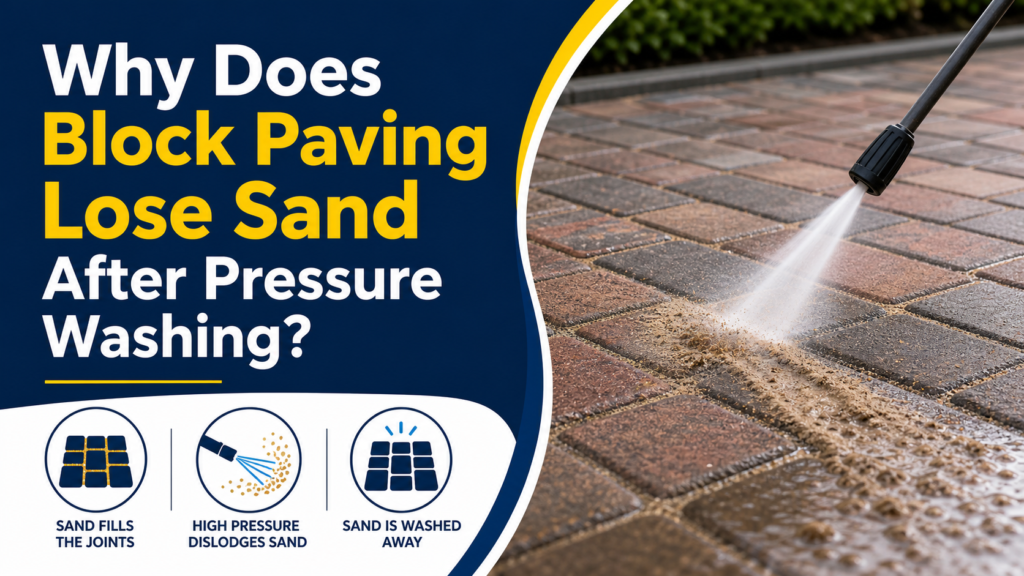
A pressure washer works by firing water at high velocity, and that force does not stop at the surface of the block. Water finds its way into the joints, and if the pressure is strong enough, it physically pushes loose sand particles up and out along with the dirt being removed.
The steeper the angle of the lance and the closer it is held to the surface, the more force is directed straight down into the joints rather than across the surface, which increases how much sand is displaced.
2. The Existing Sand Was Already Loose or Degraded
Jointing sand does not last forever. Over years of weather, freeze and thaw cycles, and general wear, it naturally compacts, washes down, or gets colonised by moss and weed roots that break it apart from within. If your paving has not been resanded in some time, the sand sitting in the joints before cleaning may already be loose and only lightly held in place. Pressure washing simply finishes the job that time had already started.
3. Moss, Algae, and Weed Removal Disturbs the Joints
Moss and weeds do not just sit on top of block paving, their roots grow down into the jointing sand itself. When pressure washing removes that growth, it inevitably pulls sand up along with it. This is one of the main reasons heavily mossed or overgrown driveways lose noticeably more sand during cleaning than paving that has been well maintained.
4. Incorrect Technique or Equipment
This is where the difference between a careful clean and a rushed one really shows. Holding the lance too close, using a narrow jet instead of a fan pattern, or working the same spot repeatedly all increase how much sand is stripped from the joints. Professional cleaning teams deliberately use wider fan nozzles, keep the lance at a safe distance, and work in smooth, overlapping passes specifically to reduce this kind of sand loss while still achieving a thorough clean.
5. Shallow or Thin Joints
On some driveways, particularly older ones or those laid with narrower joint gaps, there simply is not much depth of sand to begin with. Even gentle cleaning can visibly empty these joints because there was so little material there in the first place.
Is It Normal to Lose Some Sand? Or Should You Worry?
Some sand loss during pressure washing is completely normal and expected, even when the job is carried out to a professional standard. What matters is not whether you lose any sand at all, but how much, and what happens next.
A small amount of surface sand disturbance that leaves the joints still reasonably full is nothing to be concerned about. Wide, visible gaps that expose the sides of the blocks are a different matter and should always be addressed before the driveway is used normally again.
The honest answer to whether pressure washing always requires resanding afterwards is that in the vast majority of cases, yes, it does. Treating resanding as an optional extra rather than a standard final step is one of the most common corners cut in this industry, and it is one that catches up with homeowners later.
What Happens If You Do Not Replace the Lost Sand
Skipping the resanding step rarely causes an immediate problem, which is exactly why it gets overlooked. The real cost shows up gradually.
Block movement. Without sand locking them together, blocks can begin to shift slightly under the weight of vehicles or heavy footfall, particularly at turning points on a driveway.
Uneven surfaces. As blocks move independently of one another, dips and high points start to appear across the paving, which is both unsightly and a trip hazard.
Edge creep. The outer rows of blocks, which have the least support, are especially prone to spreading outward over time once the jointing sand that held them in place is gone.
Faster weed and moss return. Empty joints are the perfect environment for weed seeds and moss spores to establish themselves, meaning the very growth you just paid to have removed can reappear more quickly than it otherwise would.
More water penetration. Open joints let more rainwater flow straight down to the sub base rather than draining properly across the surface, which can accelerate long term wear.
None of these issues happen overnight, but they compound. A driveway that has gone a year or two without its jointing sand topped up after cleaning is a driveway that is quietly losing structural integrity the whole time.
How to Tell If Your Paving Needs Resanding
Once your driveway or patio has dried out fully after a clean, take a close look at the joints.
If the sand still sits close to the top of each joint and the surface feels firm underfoot, a light top up may be all that is needed. If you can clearly see a gap between the sides of neighbouring blocks, or if the blocks feel slightly loose when you press on them, resanding is necessary rather than optional. Newly installed paving with tightly compacted joints and small patio areas that see no vehicle traffic are the exceptions where minimal sand loss sometimes means resanding is not urgent, but even then the joints are worth checking rather than assuming.
For any driveway that carries regular vehicle weight, treat resanding as a standard part of the job rather than an add on.
The Right Way to Resand Block Paving
Getting this step right matters just as much as the cleaning itself.
Let the surface dry completely. This is the single most important rule. Sand brushed into damp joints will clump together instead of settling properly, leaving the joints only partially filled and prone to washing back out again with the next rainfall. Depending on the weather, this can take anywhere from several hours to a full day.
Use the correct kiln dried sand. This fine, moisture free sand is specifically designed to pack tightly into narrow joints. General building sand or damp sand will not perform the same job.
Spread and brush at an angle. Sand should be spread across the surface and worked into the joints with a stiff broom, ideally at roughly a 45 degree angle to the joint lines. This helps push sand down into the gap rather than dragging it back out.
Compact in more than one direction. Brushing the sand in a couple of different directions helps it settle and pack down fully rather than sitting loosely on top.
Check and top up. Once the first pass has settled, it is common to need a second application to fully fill the joints, particularly on paving that lost a significant amount of sand during cleaning.
If your paving has been heavily cleaned, shows visible movement, or you are simply unsure how much sand has actually been lost, a professional assessment is the safer route. A driveway can look fine from a standing glance while still having joints that are far emptier than they appear.
How to Minimise Sand Loss Before It Happens
While some sand loss is unavoidable, the amount lost during pressure washing depends heavily on technique. This is one of the clearest differences between a DIY clean with a domestic pressure washer and a professionally managed clean.
Lower, controlled pressure settings suited to the condition of the paving, a wider fan nozzle rather than a pinpoint jet, keeping the lance at a safe working distance, and moving in smooth overlapping passes rather than lingering on one area all reduce how aggressively the joints are stripped. At Platinum Exterior Cleaning, our approach to driveway and block paving cleaning is built around this balance: powerful enough to properly lift dirt, moss, and stains, while controlled enough to protect the jointing sand that keeps your paving structurally sound.
DIY Resanding vs Professional Aftercare
Resanding is something a confident homeowner can attempt, but it is easy to underestimate how much sand has actually been lost, or to apply it before the surface is properly dry. Both mistakes lead to joints that look filled at first glance but fail within a few months.
A professional service builds resanding into the cleaning process as standard, checks the joints properly once the surface has dried, and applies the correct grade of sand in sufficient quantity to restore real stability rather than just a cosmetic finish. If you would like an assessment of your own driveway or patio, our team is happy to advise on the safest approach for your specific paving. You can find out more about our wider patio and decking cleaning services if the same question applies to another area of your outdoor space.
Protecting Your Paving for the Long Term
Resanding restores stability, but it is not the only step worth considering if you want to slow down how quickly moss, algae, and weeds return. Many homeowners also choose to apply a biocide treatment after cleaning to discourage regrowth, or look into sealing as a longer term option that helps stabilise jointing sand and reduce staining between cleans. Neither is essential for every driveway, and the right choice depends on the age, condition, and exposure of your paving.
If your driveway has seen better days, our article on how professional driveway cleaning can add value to your home covers the wider benefits of keeping block paving well maintained, while our guide to driveway cleaning in the UK and what works best for block paving looks more broadly at the cleaning methods suited to this surface type.
Frequently Asked Questions
Does all block paving lose sand when pressure washed?
Almost all block paving loses some sand during pressure washing, even when the work is carried out carefully. The amount varies depending on the age of the paving, how much growth was removed, and the technique used.
Can I just leave the joints empty if the driveway still looks fine?
It is not advisable. Movement and weed growth often develop gradually, so a driveway that looks fine immediately after cleaning can still be at risk if the joints are left unfilled.
How soon after pressure washing should I resand?
As soon as the surface is completely dry. Depending on the weather, this is usually the same day or the following day.
Does resanding apply to patios as well as driveways?
Yes, if the patio is made from block paving with sand filled joints. Concrete, tarmac, and natural stone patios do not rely on jointing sand in the same way.
Will resanding stop weeds from coming back completely?
It significantly reduces the chances, since it removes the gaps weeds need to establish themselves, but it is not a permanent guarantee. Combining resanding with a biocide treatment gives the best long term results.
If you are noticing gaps in your block paving after a recent clean, or your driveway is overdue for attention altogether, get in touch with Platinum Exterior Cleaning and we will be happy to take a look and advise on the right next steps.