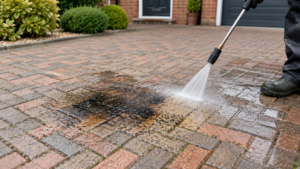

Pressure washing can remove oil stains from block paving, but only when it is used as one part of the right process. On its own, a pressure washer mostly clears the oil sitting on the surface and the dirt around it. The oil that has already soaked into the block usually needs a degreasing treatment first. That is why so many homeowners blast a driveway for an hour and still see a dark patch where the car is parked.
This guide explains why oil clings to block paving, when pressure washing helps, when it makes things worse, and what to do for fresh and old stains. If you live in Bournemouth, Poole, Christchurch or Ringwood and want the job done properly, you will also see where professional help makes sense.
The Short Answer
| Situation | Will pressure washing alone work? |
| Fresh spill, caught within hours | Often a good improvement once the oil has been absorbed and degreased |
| Light surface film from a slow drip | Partly, usually after a degreasing treatment |
| Stain that has been there for weeks | Rarely, it normally needs repeat treatment |
| Deep, old staining under a parked car | Unlikely to disappear fully, but it can usually be lightened a great deal |
Pressure washing is the rinse stage, not the whole cure. The real work is done by breaking the oil down first, then lifting it out and rinsing it away.
Why Oil Stains Are So Hard to Remove From Block Paving
Block paving looks solid, but both concrete and clay blocks are porous. They contain thousands of tiny channels and voids. When oil lands on the surface, it does not sit there like water on glass. It travels into those pores through capillary action, a bit like a paper towel drawing up a spill.
Several things make block paving especially prone to staining:
- Open pores: Concrete blocks in particular have a textured, absorbent face.
- Joint sand: The sand between blocks soaks up oil and carries it sideways, so a stain often looks bigger than the original drip.
- Slow leaks: Most driveway stains are not one big spill. They build up from small drips over months, so the oil goes deeper each time.
- Weather: Rain pushes oil further down, and warm sun thins it so it spreads and sinks faster.
Once oil has reached the inside of a block, a jet of water cannot pull it out. Oil and water do not mix, so water alone just glides over the top.
Can Pressure Washing Remove Oil Stains? What It Does Well and What It Cannot Do
What pressure washing is good at
A pressure washer is excellent for removing loose dirt, algae, moss and the grime that surrounds an oil mark. It is also the right tool for rinsing away degreaser once it has done its job. Cleaning the surrounding area often makes a stain look smaller and sharper.
Where it falls short
- It does not break down oil chemically.
- It can push surface oil sideways into clean areas or deeper into the joints.
- Turning the pressure up does not help. Too much force can etch the block face, strip the sand and leave a pale, patchy finish that is more noticeable than the original stain.
That last point matters. A lot of damaged driveways were not harmed by oil, they were harmed by someone trying to blast it out.
Know Your Stain Before You Treat It
Not all driveway marks are the same, and the type of fluid changes how it behaves.
| Fluid | What it looks like | How it behaves |
| Engine oil | Dark brown to black, often a round patch | Thick, sinks steadily, usually concentrated under the engine |
| Transmission or hydraulic fluid | Red or reddish brown | Thinner, spreads out a little wider |
| Diesel and fuel | Rainbow sheen, then a faint darker shadow | Very thin, travels quickly and can reach a large area |
| Power steering or brake fluid | Light brown or yellowish | Can mark blocks and may affect sealers |
Fuel and thinner fluids spread quickly but are often easier to lift once treated. Thick engine oil sits in one place and goes deeper, so it can need more than one treatment.
How Old Is the Stain? Why Timing Changes Everything
Stain age is one of the biggest factors in whether you get a clean result.
- Under 24 hours: The oil is mostly near the surface. Quick action gives the best chance of near complete removal.
- A few days to a few weeks: The oil has started to bond with the block. Degreasing is usually essential.
- Several months: The oil has moved deep and may have oxidised. Expect multiple treatments.
- A year or more: The stain may have become part of the block. Significant lightening is realistic, but a perfect match to the surrounding paving is not always possible.
Sunlight and heat speed this process up, which is why a spill on a summer afternoon can be harder to shift than one in a cool, damp week.
What to Do Straight Away When Oil Hits Your Driveway
If you catch a spill early, you can often prevent a permanent mark.
- Blot, do not rub. Rubbing pushes oil deeper into the block.
- Cover with an absorbent. Cat litter, sawdust or bicarbonate of soda all work. Pile it thickly over the whole stain and a little beyond the edge.
- Leave it for several hours. Overnight is better. The powder draws oil up out of the block.
- Sweep it up and dispose of it safely. Do not wash it into a drain.
- Scrub with warm water and washing up liquid. Use a stiff brush and work in sections.
- Rinse with a low pressure hose or a gentle pressure wash.
This simple routine can work well on a fresh stain. For older marks, it is only the first step.
The Right Way to Use a Pressure Washer on Oil Stains
If you are going to use a pressure washer, the order of work matters more than the power.
Step 1: Remove loose debris
Sweep the area and clear leaves, grit and surface dirt. Oil trapped under debris is harder to treat evenly.
Step 2: Absorb any remaining surface oil
If the stain is fresh, absorb it first. Do not pressure wash raw oil, because the jet will spread it.
Step 3: Apply a degreaser
Use a degreaser that is suitable for block paving and avoid acid based products, which can damage the surface and joints. Always test a small, hidden patch first. Apply the product to the dry stain and let it sit for the time the manufacturer recommends, typically somewhere between 15 and 20 minutes. This dwell time is the part most people rush, and it is where the chemistry does its work.
Step 4: Agitate
Scrub with a stiff brush, working diagonally across the joints rather than along them. This helps the degreaser reach deeper without lifting the sand.
Step 5: Rinse with controlled pressure
Now the pressure washer comes in. Use a low to medium setting, a fan nozzle rather than a pencil jet, and keep the lance moving. Hold the nozzle around 30 to 40 cm from the surface at a slight angle of roughly 45 degrees. Never hold the jet still on one spot.
Step 6: Repeat if needed
Older stains rarely come out in one go. It is normal to repeat the degrease and rinse cycle two or three times, leaving the surface to dry between rounds so you can judge the true result.
Step 7: Refill the joints
Pressure washing removes sand from between blocks. Once the surface is fully dry, brush in fresh kiln dried jointing sand so the blocks stay locked together and weeds have less chance to return.
Does Hot Water Make a Difference?
Yes, it can. Heat thins oil and softens grease, so a degreaser works more effectively and rinses away more easily. Hot water pressure washing is often used on heavier staining for this reason. It does not replace the need for a degreaser, but the two together are more effective than cold water alone.
When You Should Not Pressure Wash Block Paving
There are times when pressure washing is the wrong choice:
- New paving: Paving laid in the last two to three months may not have settled, and the sand is still bedding in.
- Loose or uneven blocks: High pressure can lift them or wash out the bedding layer.
- Poorly jointed driveways: If the joints are already thin or empty, a pressure washer will make it worse.
- Heavily weathered or flaking blocks: The surface may already be fragile.
- Fresh, unabsorbed oil: The jet will smear it across the surface.
In these cases, a gentler method or a professional assessment is the safer route.
Household Products: What Works and What Does Not
| Product | Verdict |
| Cat litter, sawdust, bicarbonate of soda | Good for fresh spills, best used immediately |
| Washing up liquid | Helpful on light, recent marks |
| WD 40 | Not recommended, it can leave its own residue |
| Cola | Does not lift soaked in oil |
| Bleach | Not suited to grease, can discolour blocks |
| Acid based cleaners | Avoid, they can etch the surface and damage joints |
| Wire brushes | Avoid, they scratch the blocks |
Household products have their place for fresh stains. For anything older, they tend to lighten the surface but leave the deeper oil behind.
Common Myths About Pressure Washing and Oil Stains
Myth: A stronger jet gives a better result. Higher pressure does not dissolve oil. It only increases the risk of damage.
Myth: Oil stains fade by themselves. Rain and sun may lighten a mark slightly, but the oil remains in the block and often spreads.
Myth: One pass will do it. Deep stains often need repeat treatment, and a good cleaner will say so honestly.
Myth: Pressure washing alone is a full treatment. It is a rinsing tool. Without a degreaser, most of the oil stays where it is.
Can an Oil Stain Be Removed Completely?
Often it can be reduced dramatically, and sometimes it disappears entirely, but a guarantee is not realistic for every stain. Results depend on:
- The age of the stain
- The type of block (concrete, clay or textured finish)
- How deep the oil has travelled
- Whether the paving has been sealed
- The colour of the blocks, since darker or lighter blocks show stains differently
- How many treatments are carried out
A good contractor will inspect the stain, explain what is likely, and tell you if a faint shadow may remain.
How Weather in Bournemouth and Poole Affects Oil Stains
The south coast climate has a real impact on driveways:
- Rain: Moves oil downward and can spread it through wet joint sand.
- Sunshine: Warms the oil, thins it and drives it deeper.
- Frost: Water trapped in porous, oil contaminated blocks can freeze and expand, making the surface more fragile over time.
- Salt in the air: Coastal conditions can add to general weathering, which makes the surface more absorbent.
If you spot a spill, acting before the next rainy spell makes a noticeable difference.
How to Protect Block Paving From Future Oil Stains
Prevention is far easier than removal.
- Fix leaks promptly: A slow drip is the most common cause of deep stains.
- Use a drip tray or mat: Place one under any vehicle that is known to leak.
- Vary where you park: Repeated parking in the same spot concentrates any drips.
- Top up fluids away from the driveway: Or do it over a tray or cardboard.
- Clean spills straight away: The first hour matters most.
- Sweep and wash regularly: A clean surface makes problems easier to spot.
- Consider sealing: A good quality paving sealer slows the rate at which liquids soak in, so spills sit on the surface for longer and are easier to remove. Sealer needs reapplying over time, and it works best on clean, dry, well jointed paving.
Sealing is a protective measure, not a magic shield. It buys you time to react, but oil should still be cleaned off promptly.
Protecting Your Garden and Drains
Degreasers and oil run off need to be handled with care. Keep rinse water away from lawns, borders, ponds and surface water drains. Collect and dispose of absorbent materials safely. Wear gloves and eye protection, and keep pets and children off the area while products are working. Always follow the manufacturer’s instructions.
DIY or Professional Cleaning: Which Is Right for You?
DIY is reasonable when:
- The stain is fresh and small
- The paving is in good condition
- You have a suitable pressure washer and know how to use it
Professional cleaning is worth considering when:
- The stain is old, large or has returned after cleaning
- The paving is sealed, coloured, or has delicate joints
- Several areas of the driveway are affected
- You have tried household methods and the mark is still there
- You want the joints, sealing and finish handled properly afterwards
A professional will identify the surface, choose the right degreaser, control pressure and water use, and know when to stop before the block is harmed.
Professional Block Paving and Driveway Cleaning in Bournemouth and Poole
If oil stains are spoiling the look of your driveway, Platinum Exterior Cleaning can assess the surface and recommend the right approach for your block paving. Our driveway and block paving cleaning service covers Bournemouth and the surrounding areas, including Poole, Christchurch and Ringwood, subject to location and property requirements.
Cleaning the driveway often pairs well with other outdoor work. Many customers also look at our patio and decking cleaning so the whole front and back of the property matches, or our roof cleaning and gutter and fascia cleaning to keep the exterior looking consistent.
To talk through your driveway, call 07734 928740 or email info@platinumexteriorcleaning.co.uk. Our team is available Monday to Friday, 10:00AM to 7:00PM. You can also use the contact form on our website to book an assessment.
Frequently Asked Questions
Can pressure washing remove oil stains from block paving?
It can, but usually not on its own. Pressure washing works best as the final rinse after the oil has been absorbed and treated with a degreaser. Without that chemical step, much of the oil stays inside the block.
Does hot water pressure washing work better on oil?
Yes. Heat thins the oil and helps a degreaser break it down, which usually makes rinsing more effective than cold water alone.
Will a pressure washer damage my block paving?
It can if the pressure is too high, the nozzle is too close, or the jet is held in one place. It can also remove joint sand. Controlled pressure and re sanding afterwards reduce the risk.
What is the best way to remove fresh oil from a driveway?
Blot it, cover it with an absorbent such as cat litter or bicarbonate of soda, leave it for several hours, sweep it up, then scrub with warm water and detergent.
Does bicarbonate of soda remove oil stains?
It helps lift fresh oil when applied quickly and left to sit. It is far less effective on old stains.
Can I use WD 40 or bleach on oil stains?
Neither is recommended. WD 40 can leave residue, and bleach is not designed to break down grease and may discolour the blocks.
Will old oil stains ever go away on their own?
They may lighten slightly with weather and wear, but they rarely disappear without cleaning.
How many treatments does an old stain need?
Deep or old stains often need more than one round of degreasing and rinsing. The exact number depends on the age of the stain and the type of block.
Can oil stains be prevented with sealing?
Sealing helps slow absorption and makes spills easier to clean, but it does not make paving oil proof. Prompt cleaning is still important.
Is it safe to use a pressure washer on newly laid paving?
It is best to wait. Paving that has been down for less than two to three months may not be fully settled, and the sand can be washed out easily.
Final Thoughts
So, can pressure washing remove oil stains from block paving? Yes, when it is used properly and alongside the right degreasing treatment. Pressure alone is rarely enough, and too much of it can do more harm than the stain itself. Act quickly on fresh spills, treat older marks with patience, protect the joints, and consider a professional assessment when the stain is stubborn.
If you would like help with a stained driveway in Bournemouth, Poole, Christchurch or Ringwood, get in touch with Platinum Exterior Cleaning today.