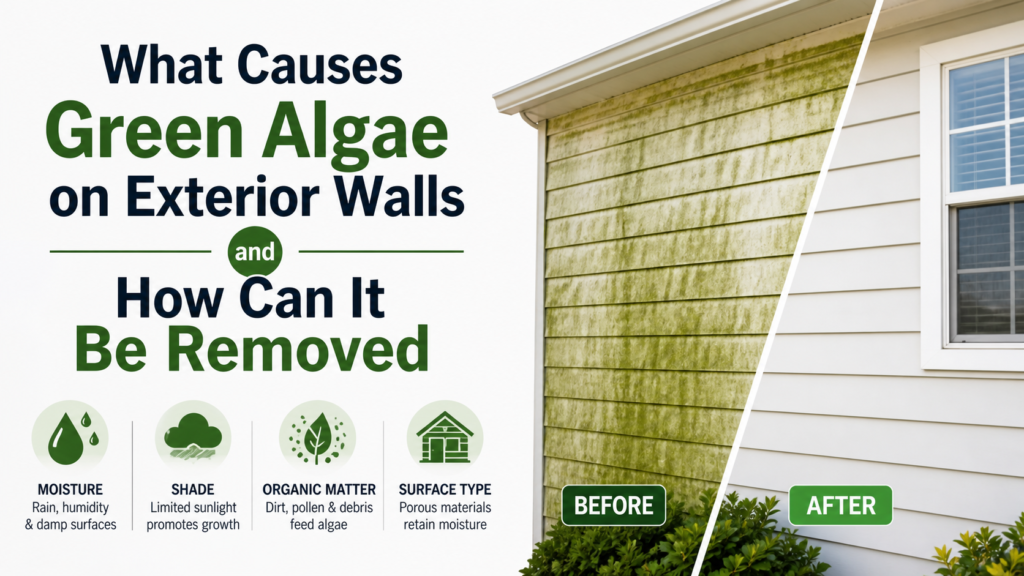
If you have noticed a green tinge creeping across your render, brickwork or cladding, you are not alone. Green algae is one of the most common problems facing homeowners across Bournemouth, Poole, Christchurch and Ringwood, and the damp, mild conditions we get in this part of the UK make it almost impossible to avoid completely. The good news is that green algae can be removed safely and, with the right approach, kept away for much longer than most people expect.
In this guide, we explain exactly what causes green algae to grow on exterior walls, why it appears in some spots and not others, the safest ways to remove it, and how to stop it coming straight back once your walls are clean.
What Is Green Algae and Why Does It Turn Walls Green?
Algae is a simple, plant like organism that survives on moisture, shade and airborne nutrients rather than soil. Unlike moss, it does not need much of a foothold to establish itself. A thin film of dampness on a porous wall is often all it takes. Once algae spores land on a surface that stays wet for long enough, they begin to multiply, forming the greenish, sometimes slightly slimy coating that spreads across render, brick, stone and painted masonry.
It is worth knowing that not every patch of discolouration is algae. Walls can also develop black staining, lichen, mould or general organic soiling, and each of these can look similar from a distance but behaves differently and often needs a slightly different approach to remove. Green staining, however, is by far the most commonly reported type on UK properties, largely because it thrives in such a wide range of conditions and spreads quickly once established.
What Causes Green Algae on Exterior Walls
Algae needs three things to survive: moisture, shade and a food source. Most UK properties provide all three at some point during the year, which is why the problem is so widespread. Here are the most common causes we see on properties across the local area.
Persistent Dampness
Frequent rainfall, cool temperatures and limited direct sun mean that many exterior walls in the UK simply do not dry out quickly. Surfaces that remain damp for extended periods give algae exactly the environment it needs to take hold and spread.
Shaded and North Facing Elevations
Walls that receive little or no direct sunlight are far more prone to algae growth. North and east facing elevations dry more slowly after rain or overnight dew, which means they stay damp for longer stretches than south facing walls that get regular sun exposure.
Poor Airflow Around the Property
Trees, fences, hedges, extensions and neighbouring buildings can all restrict airflow around a wall. When air cannot circulate freely, humidity becomes trapped against the surface and evaporation slows right down, creating ideal conditions for algae to establish itself.
Leaking or Blocked Gutters and Downpipes
This is one of the most common and most overlooked causes of algae on walls. When a gutter overflows, a downpipe leaks, or a hopper becomes blocked, water runs freely down the face of the building instead of being carried away properly. The result is a constantly wet strip of wall, often directly below the fault, where algae takes hold fastest. If you have noticed green streaking running down from your roofline, a blocked or damaged gutter is very often the underlying cause. We cover this in more detail in our guide on how blocked gutters can lead to expensive property repairs, and regular gutter and fascia cleaning is one of the simplest ways to remove this cause at the source.
Porous Building Materials
Render, brick, stone, concrete and even some painted finishes are porous to some degree. This means they naturally absorb and hold a certain amount of moisture rather than shedding it completely. That trapped moisture gives algae spores a surface to grip onto and feed from, particularly where the material has not been sealed or treated.
Organic Debris
Pollen, dust, leaf matter and bird fouling all settle on exterior walls over time. This organic material acts as a food source for algae, accelerating growth once moisture is already present. Properties surrounded by trees or dense planting tend to see this problem more often, simply because there is more organic debris in the immediate environment.
Condensation and Cold Spots
In winter, poorly insulated walls can develop cold spots where condensation forms on the surface. This adds another source of moisture that has nothing to do with the weather outside, and it can keep certain sections of a wall damp even during drier periods.
Is Green Algae Just a Cosmetic Problem?
It is tempting to see green algae as nothing more than an appearance issue, but that is not the full picture. Algae holds moisture against the surface it grows on, and over time this can contribute to deeper staining, a persistently damp appearance, slippery adjacent surfaces such as paths and steps, and accelerated soiling of the wall as dirt and debris stick more easily to the damp film.
There is also a wider point worth considering if you are planning to sell your property. Green algae on a front elevation is one of the first things a buyer notices, often before they have even reached the front door, and it can raise questions about how well the rest of the property has been maintained. It is also something that will not go unnoticed during a property survey, since visible algae growth is treated as a sign that warrants a closer look at moisture, drainage and the condition of the underlying materials. Addressing it before marketing a property, or simply before it spreads further, is a straightforward way to protect both the appearance and the long term condition of your walls.
How Different Wall Surfaces Are Affected by Algae
The right removal method depends heavily on what your wall is actually made from. Treating every surface the same way is one of the most common mistakes homeowners make, so it is worth understanding how algae behaves on each type of finish.
Rendered Walls
Modern render systems, including silicone, monocouche, acrylic and painted render, are among the most commonly affected surfaces because they are slightly porous and hold moisture after rainfall. Render can also mark easily if cleaned too aggressively, so a gentler approach is almost always the better choice here.
Brick and Masonry
Brickwork tends to be more robust than render, but older or softer bricks and weakened pointing can still be damaged by overly forceful cleaning methods. Algae often gathers in the mortar joints and textured areas first before spreading across the face of the brick.
Natural Stone
Stone can react very differently depending on its type and porosity. Some stone is more absorbent and sensitive to certain cleaning products, so identifying the material correctly before treatment matters just as much as it does with render.
Cladding and Painted Surfaces
Cladding and painted masonry can be cleaned effectively, but ageing coatings, failing paint or worn seals change how the surface should be treated. A method that works well on a sound, recently painted wall may not be appropriate on an older, weathered one.
How to Remove Green Algae From Exterior Walls
Removing algae properly involves more than simply blasting the wall until the green disappears. A careful, step by step approach gives a better result and protects the surface underneath.
1. Inspect the Wall and Identify the Cause
Before any cleaning begins, take a proper look at the wall and the area around it. Check for leaking gutters, overhanging branches, damaged pointing or areas that never seem to dry out. If the underlying cause of the dampness is not addressed, the algae is likely to return quickly no matter how thoroughly the wall is cleaned.
2. Remove Loose Growth First
Using a soft, dry brush, gently work over the surface to loosen dust, debris and any loose algae. This simple step makes whatever cleaning method you choose afterwards significantly more effective, since the cleaning solution can make direct contact with the remaining growth rather than sitting on top of loose dirt.
3. Choose the Right Cleaning Method for the Surface
For most exterior walls, especially render, painted masonry and older brick, a controlled low pressure wash combined with a suitable cleaning treatment gives the best results. High pressure jet washing might remove visible algae quickly, but it carries real risks. It can strip paint, scar render, force water behind cladding, dislodge weak pointing and leave uneven marks across the wall. On more robust brick or stone, carefully controlled pressure can sometimes be appropriate, but this should always be assessed on a case by case basis rather than applied as a default.
Many professional cleaners now favour a gentler, chemical led approach over high pressure alone. This method treats the biological growth directly rather than simply stripping it from the surface, which tends to give a more even finish and slower regrowth when carried out correctly.
4. Apply a Suitable Cleaning Solution
A dedicated exterior wall cleaner or biocidal treatment, applied evenly across the surface, is generally far more effective than household products such as diluted bleach or white vinegar. Specialist products are designed to break down the algae at a biological level rather than just lifting the visible staining, which gives a cleaner, longer lasting result. Always follow the manufacturer’s guidance closely, test a small, inconspicuous area first, and take care around plants, pets and nearby surfaces.
5. Allow the Correct Dwell Time
Once applied, the solution needs time to work. This is usually somewhere between fifteen and thirty minutes, though it varies by product. Avoid letting the solution dry out completely on the surface in hot or windy weather, as this can lead to streaking. Working in smaller, manageable sections helps keep this under control.
6. Agitate Stubborn Areas
Heavier growth around window sills, textured render or sheltered corners may need a little extra help. A soft bristled brush worked gently in a circular motion is usually enough. Avoid stiff wire brushes on render and softer masonry, as these can damage the surface rather than simply cleaning it.
7. Rinse Thoroughly
Once the treatment has done its work, rinse the wall carefully with clean water at a controlled, low pressure. Take care around windows, frames, metalwork and nearby planting, and make sure runoff is directed away from sensitive areas such as ponds or borders.
8. Inspect and Repeat if Needed
Let the wall dry fully before judging the result, since some staining continues to lighten over the following days. If patches remain, it is usually better to reassess the approach rather than simply applying a stronger solution the second time around.
DIY Cleaning Versus Calling in a Professional
Light, surface level algae on an easily accessible wall is often manageable as a DIY job with the right care and a gentle approach. However, there are several situations where calling in a professional makes far more sense.
Heavily contaminated walls, tall elevations that require working at height, delicate or coloured render, older properties with fragile pointing, and any wall where the cause of the dampness is not immediately obvious are all better handled by an experienced team. Professional exterior cleaners have access to controlled low pressure equipment, correctly diluted treatments and the experience to judge how a particular surface will react before committing to a full clean. This reduces the risk of damage and generally produces a longer lasting result than a rushed DIY attempt.
If you are dealing with algae on a roof as well as the walls beneath it, this is well worth tackling together, since moss and algae often travel between the two. Our roof cleaning service is designed to safely remove exactly this kind of organic growth without damaging tiles or slates.
How to Prevent Green Algae From Coming Back
Cleaning the wall is only half the job. Preventing regrowth is where real value is added, and while you cannot change the British weather, you can remove most of the conditions that allow algae to thrive.
Fix leaking or blocked gutters. As covered earlier, this is one of the single biggest causes of repeat algae growth. A well maintained gutter system keeps water running where it should, away from the wall rather than down it. Take a look at our guide on the hidden costs of ignoring roof and gutter maintenance to understand why this matters more than most homeowners realise.
Cut back nearby vegetation. Trimming trees, hedges and shrubs close to the property improves both airflow and sunlight reaching the wall, both of which help surfaces dry out faster after rain.
Improve airflow generally. Where possible, avoid stacking items, planters or furniture directly against exterior walls, since this restricts air movement and traps humidity against the surface.
Consider a protective treatment. A biocidal or algae resistant treatment applied after cleaning can help slow regrowth considerably, particularly on shaded, north facing elevations that are always going to be more prone to the problem than sunnier walls.
Schedule regular maintenance cleans. Catching algae early, before it becomes deeply embedded, makes every future clean quicker and less aggressive. Many homeowners in Bournemouth, Poole, Christchurch and Ringwood find that a proactive clean every twelve to twenty four months keeps their property looking its best year round, though shaded or tree lined properties often benefit from more frequent attention. As we head into wetter months, it is also worth reading our guide on preparing your home’s exterior for autumn rain and storms, since this is typically when algae growth accelerates fastest.
It is also worth setting realistic expectations. A shaded, north facing rendered wall beside mature trees will simply never stay clean as long as a sunny, south facing brick wall with good airflow. Understanding this helps homeowners plan sensible maintenance rather than expecting a single clean to solve the problem permanently.
Common Mistakes to Avoid
Using too much pressure. A wall might look clean immediately after a high pressure blast, but scarred render, blown paint and damaged brick faces are common long term consequences, and the algae organism itself is often left untreated beneath the surface.
Skipping a test patch. This is especially important on coloured or painted render, where a small test area can reveal unwanted colour change or streaking before the whole wall is affected.
Letting solution dry on the wall. This tends to cause patchy, streaky results. Working in smaller sections during cooler, overcast conditions generally gives a far more even finish than working in direct sun.
Ignoring the surrounding area. Plants, metalwork, decking and paving near the wall can all be affected by runoff if preparation and rinsing are not handled carefully. If algae has also spread to a nearby patio, our guide on common causes of black spots on patios and how to remove them explains how to tackle that surface safely too.
Assuming rain will wash it away. In reality, rain tends to make algae worse by keeping the surface consistently damp. Left untreated, it will usually continue to spread rather than disappear on its own.
Frequently Asked Questions
What causes green algae to grow on exterior walls?
Green algae grows where moisture, shade and organic nutrients are all present. Common triggers include leaking or blocked gutters, poor airflow, shaded or north facing elevations, porous building materials and nearby vegetation that drops leaves, pollen and debris onto the wall.
Is algae on my walls dangerous?
Algae itself is not typically dangerous to health, but it holds moisture against the wall surface, which can contribute to ongoing dampness, staining and gradual deterioration of the underlying material if left untreated for a long time.
Can I pressure wash algae off my walls myself?
You can, but it needs to be done carefully and only on surfaces robust enough to handle it, such as sound brick. Render, painted masonry and older or softer materials are much more likely to be damaged by high pressure, so a gentler, controlled approach is usually safer and more effective.
Will algae come back after cleaning?
It can, particularly on shaded, damp walls where the underlying cause has not been addressed. Fixing gutters, improving airflow, trimming vegetation and applying a protective treatment after cleaning all help slow regrowth significantly.
How often should I clean algae off my exterior walls?
Most properties benefit from a check and clean every twelve to twenty four months, though shaded elevations, properties near trees, or walls affected by a known drainage issue may need more frequent attention.
Does green algae mean my walls are damp?
Not necessarily on its own, but persistent green algae is often a sign that a particular area of the wall is staying wetter for longer than it should, whether that is due to shade, poor drainage or a fault such as a leaking gutter. It is worth investigating the cause rather than treating the algae as an isolated issue.
Get Expert Help With Algae on Your Walls
Green algae on exterior walls is extremely common across Bournemouth, Poole, Christchurch and Ringwood, but it does not have to be a permanent feature of your property. With the right diagnosis, the correct cleaning approach for your specific wall surface, and a few sensible steps to reduce future moisture, most homes can stay noticeably cleaner for far longer between treatments.
At Platinum Exterior Cleaning, we take the time to assess each property individually, choosing the safest and most effective method for the surface in front of us rather than applying a one size fits all approach. If your walls, roof or gutters need attention, get in touch with our team to discuss the best way forward for your property, or learn more about us and the areas we cover.