
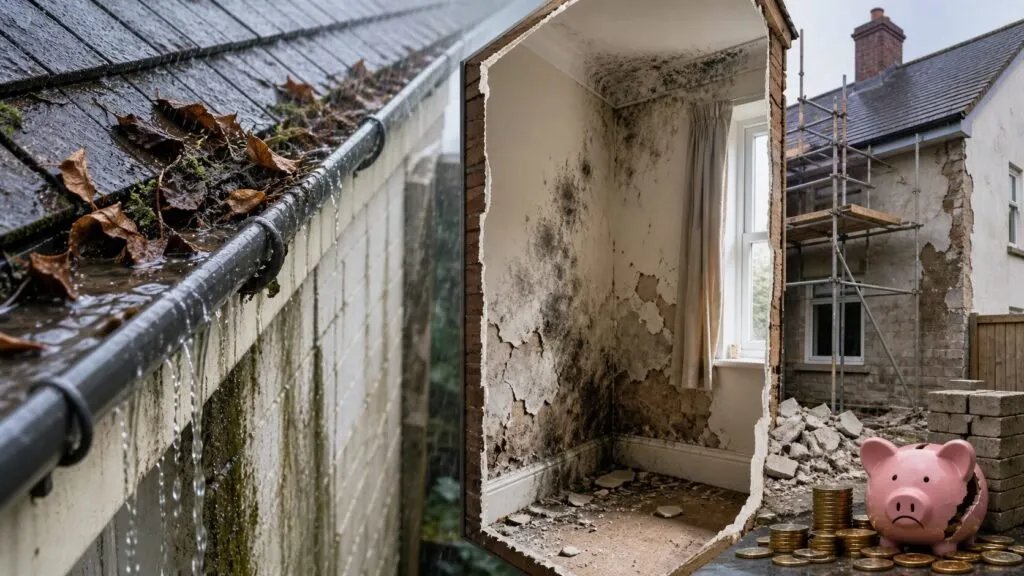
Most homeowners in Bournemouth, Poole, and Christchurch give very little thought to their gutters until water starts pouring down their walls. Your guttering system is one of the hardest-working parts of your property, quietly directing thousands of litres of rainwater away from your roof and foundations every year. When it becomes blocked, that water has nowhere to go, and the consequences can be far more damaging than most people expect.
In this guide, we’ll walk through exactly how blocked gutters cause damp, mould and costly structural repairs and what you can do right now to protect your home.
Why Gutters Are More Important Than You Think
Gutters exist for one purpose: to move rainwater safely away from your property. They channel water from the roof surface into downpipes, which carry it to the drainage system and away from your walls, fascias, and foundations. When they work correctly, they are an invisible but essential line of defence against water damage.
The problem is that gutters are positioned out of sight and are easy to forget about. Leaves, moss, silt, bird debris, and general grime gradually accumulate inside the channel. Over time, this creates a blockage. Once that blockage forms, even a moderate amount of rainfall can cause water to overflow the sides of the gutter and run straight down the exterior of your property.
That’s when the real damage begins.
Related reading: Why Gutter Cleaning Matters More Than Ever in 2026
How Blocked Gutters Cause Damp Inside Your Home
Overflowing Water Soaks Into Your Walls
When a gutter overflows, water doesn’t simply drip harmlessly onto the ground. It runs down the external face of your walls. In older properties with solid brick construction common throughout Bournemouth and the surrounding areas, moisture is absorbed directly through the brickwork and makes its way inside.
Even in modern homes with cavity walls, overflowing water can bridge the gap between the outer leaf and inner wall, causing penetrating damp on your interior surfaces. This type of damp often appears as dark patches on walls, particularly in the corners of rooms or around window frames.
Standing Water Creates the Perfect Environment for Mould
Once moisture finds its way into your walls, it doesn’t dry out quickly. It lingers behind plasterwork, beneath wallpaper, and inside wall cavities. This persistent moisture creates the ideal conditions for black mould to take hold. Mould spreads rapidly in damp environments and is notoriously difficult to remove without first addressing the source of the moisture.
Beyond the cosmetic damage, black mould poses a genuine health risk. It can trigger respiratory problems, allergic reactions, and worsen conditions like asthma particularly in children and elderly residents. If you’ve noticed a musty smell in your home or spotted dark patches on your walls after wet weather, blocked gutters may well be the cause.
Loft Insulation and Roof Timbers Are at Risk Too
When water backs up in a blocked gutter, it can begin to sit beneath the first row of roof tiles. From there, it finds its way into the underfelt, and eventually into the loft space itself. Wet loft insulation loses its thermal properties significantly, leading to a colder home and noticeably higher energy bills.
More seriously, the roof timbers, joists, rafters, and supporting structures begin to absorb moisture. Over time, this leads to rot and structural weakening. What started as a blocked gutter can, if left unaddressed, result in a partial roof failure requiring thousands of pounds in remedial work.
The Structural Damage That Blocked Gutters Can Cause
Brickwork, Mortar and Render Deterioration
Constant exposure to overflowing water accelerates the breakdown of exterior materials. Bricks and mortar are particularly vulnerable during cold weather. When water-saturated brickwork freezes, it expands, a process that causes cracking and crumbling known as spalling. Once mortar joints begin to fail, even more water enters the wall structure, accelerating the cycle of damage.
Rendered properties face similar problems. Render that is constantly soaked by gutter overflow will stain, grow algae, and eventually begin to crack and delaminate. Not only does this look unsightly, but it also removes the waterproof barrier that render is designed to provide.
Foundation Damage from Persistent Water Pooling
Few homeowners consider that blocked gutters can affect their property’s foundations, but this is a genuine risk, particularly in properties built on clay-heavy soil, which is common across parts of Dorset. When water continually pours over the edge of a blocked gutter and pools around the base of the property, it saturates the ground. Clay soil expands when wet and contracts when dry, causing the earth beneath the foundations to shift. Over time, this can cause cracking in external walls, uneven floors, and in serious cases, movement in the main structure of the building.
Damage to Driveways, Patios and Paths
Overflowing gutters don’t just damage the property itself. Water that consistently pools in the same area will cause block paving to shift, patio slabs to lift, and pathways to become slippery with algae and moss growth. These are not only aesthetic problems they create real safety hazards for your household and visitors.
How Blocked Gutters Accelerate Roof Damage
Your roof is directly connected to your guttering system, and blockages cause problems that extend well beyond the gutter channel itself.
Moss Takes Hold and Makes Things Worse
Blocked gutters that hold standing water and decomposing debris create a perfect growing environment for moss. Once moss establishes itself, it retains moisture against the tiles and the gutter surface for extended periods. This accelerates tile decay, encourages further moss growth, and critically washes back into the gutter system, worsening the original blockage.
A blocked gutter that encourages moss growth can quickly become a roof cleaning problem too, as the moss spreads across tiles and begins to lift them at the edges.
Fascia Boards and Soffits Suffer First
The fascia boards and soffits are the first components to be affected when a gutter overflows or allows water to drip behind it. These are typically made from timber or uPVC, and while uPVC is more resistant, it is not immune. Timber fascias absorb water quickly, swell, and begin to rot. Once fascia boards deteriorate, the gutter itself can lose its fixing points and begin to pull away from the roofline, creating even greater overflow problems and potentially causing the gutter to detach entirely.
8 Warning Signs Your Gutters Are Blocked Right Now
Many homeowners don’t realise their gutters are blocked until significant damage has already occurred. These are the key signs to watch for:
1. Water overflowing the sides of the gutter during rainfall: The most obvious sign. If you see water cascading over the edge rather than flowing into the downpipe, a blockage is almost certainly present.
2. Streak marks and staining on exterior walls: Dark vertical streaks running down walls below the gutter line indicate that water is consistently overflowing and running down the facade.
3. Plants or moss growing inside the gutter: Visible greenery sprouting from your gutters means debris has accumulated to the point where vegetation has taken root. This level of blockage will not clear itself.
4. Gutters sagging or pulling away from the roofline: The weight of wet debris, standing water, and decomposing leaves can cause gutters to sag. This puts strain on fixings and brackets and can lead to detachment.
5. Damp patches on internal walls, particularly after rain: If patches of damp appear on your interior walls following periods of wet weather, overflowing gutters are a likely cause.
6. Musty smells inside the property: A persistent musty odour particularly in rooms on upper floors or in the loft, often indicates moisture is entering the structure through the roofline.
7. Pooling water around the base of the property: Water consistently gathering at the foot of an exterior wall suggests it is running down the surface rather than draining through the downpipes.
8. Gutters dripping between rainfall events: If your gutters are still dripping water long after rain has stopped, water is trapped inside rather than draining freely.
How Often Should Gutters Be Cleaned?
For most properties in the UK, gutters should be professionally cleaned at least once a year, ideally in late autumn after the majority of leaves have fallen, or in early spring before the growing season begins. Properties surrounded by trees, or those with a history of moss and lichen growth on the roof, may require cleaning twice yearly to keep the system clear.
It’s worth noting that gutter cleaning is one of the most cost-effective forms of property maintenance available. The cost of a professional clean is a fraction of what you would pay to address penetrating damp, repair rotted fascia boards, or deal with foundation movement, all of which can result from years of neglected guttering.
Related reading: How Often Should You Book Exterior Cleaning for Your Home?
What a Professional Gutter Clean Involves
When you book a gutter cleaning service with Platinum Exterior Cleaning, we don’t just scoop out visible debris. Our team carries out a thorough inspection and cleaning process that includes:
- Full debris removal: Leaves, silt, moss, and compacted material cleared from the full length of the gutter channel
- Downpipe flushing: Downpipes are checked for blockages and flushed clear to ensure water can drain freely end-to-end
- Joint and bracket inspection: We check for cracked joints, loose brackets, and any early signs of damage that could worsen over time
- Overflow check: We confirm that water flows correctly from the gutter into the downpipe without pooling or backing up
- Fascia and soffit assessment: We note any signs of moisture damage or deterioration that may need attention
Using high-reach equipment, we can safely access gutters at any height without the need for ladders in most cases, reducing risk and protecting your property from accidental damage during the cleaning process.
Why Choose Platinum Exterior Cleaning in Bournemouth?
At Platinum Exterior Cleaning, we are a locally based team serving homeowners across Bournemouth, Poole, Christchurch, and Ringwood. We understand the conditions that affect properties in this part of the UK: the coastal weather, the prevalence of moss and algae, and the older property stock that requires particular care.
Our gutter and fascia cleaning service is designed to do more than just clear a blockage. We take a whole-roofline approach, making sure water can drain freely and identifying any issues before they develop into serious problems.
We also offer a full range of complementary exterior cleaning services, including:
- Roof cleaning removing moss, lichen, and algae from tiles to protect your roof and prevent debris from washing into gutters
- Driveway and block paving cleaning restoring surfaces damaged by water runoff and algae growth
- Patio and decking cleaning safe removal of slippery growth caused by persistent moisture
Don’t Wait Until Damp Appears — Act Before the Damage Does
Blocked gutters are one of those problems that always feel like they can wait. Until they can’t. By the time damp patches appear on your interior walls, mould begins to grow, or your fascia boards start to rot, the repair bill is already growing. The damage doesn’t announce itself dramatically, it happens gradually, over weeks and months, hidden behind your walls and beneath your roof timbers.
The good news is that it is entirely preventable. A professional gutter clean once or twice a year, combined with regular attention to your roof and exterior surfaces, is all it takes to keep your property protected from water ingress.
If you’re in Bournemouth, Poole, Christchurch, Ringwood, or the surrounding area and you’d like to arrange a professional gutter clean or if you’re unsure whether your gutters need attention get in touch with the team at Platinum Exterior Cleaning today.
Frequently Asked Questions About Blocked Gutters and Damp
Can blocked gutters really cause damp inside my house?
Yes, this is one of the most common causes of penetrating damp in UK properties. When gutters overflow, water runs down external walls and, in both older solid-wall and modern cavity-wall properties, can find its way inside, causing visible damp patches, mould growth, and damage to plasterwork.
How do I know if my damp is caused by gutters rather than something else?
The most telling sign is timing. If damp patches appear or worsen after periods of heavy rain, and are located on upper walls or near the roofline, gutters are a likely cause. Streak marks on exterior walls directly beneath the gutter are also a strong indicator.
How much does professional gutter cleaning cost in Bournemouth?
Gutter cleaning costs vary depending on the size and height of the property. At Platinum Exterior Cleaning, we offer transparent, competitive pricing with no hidden fees. Contact us for a free, no-obligation quote tailored to your property.
How long does a gutter clean take?
For most standard homes, a professional gutter clean takes between one and two hours. Larger properties or those with significant blockages may take longer. We’ll give you a realistic time estimate when we carry out your free quote.
Should I clean my gutters myself?
Working at height on a ladder is one of the most common causes of domestic accidents in the UK. Professional gutter cleaners have the equipment, training, and insurance to carry out the job safely. Beyond safety, professionals can also identify issues with joints, brackets, and fascias that an untrained eye may miss.