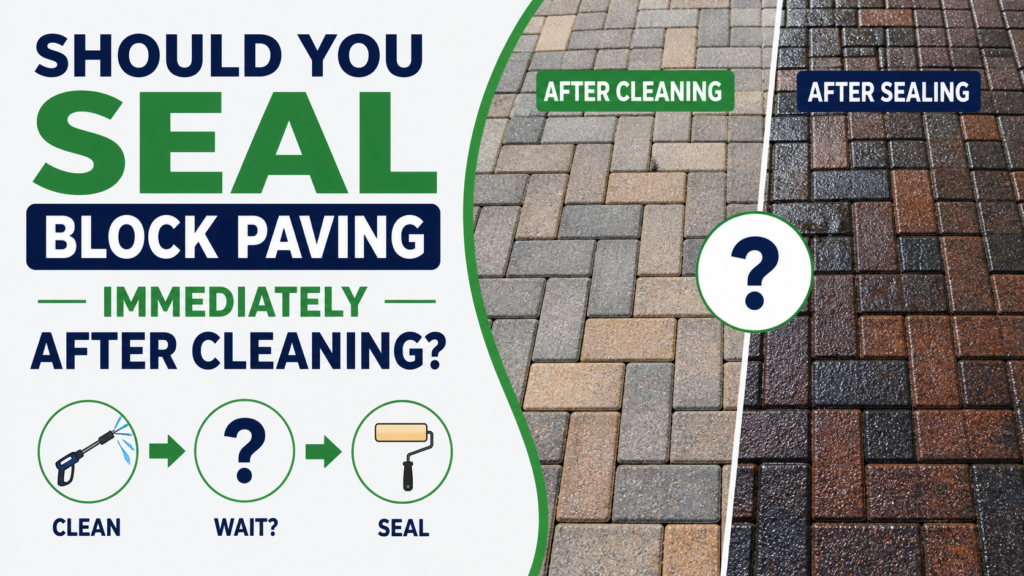
A freshly pressure washed driveway is one of the most satisfying transformations a property can get. The blocks look brighter, the joints look tidy, and the whole frontage suddenly feels new again. It is at exactly this moment that most homeowners ask the same question: should the sealant go on straight away while the driveway looks its best, or is there a reason to wait?
The short answer is that sealing block paving immediately after cleaning is one of the most common mistakes made with driveway maintenance in the UK. It is not that sealing itself is a bad idea. It is that timing changes everything about whether that sealant actually protects the surface or ends up trapping problems underneath it.
This guide walks through what sealing actually does, why rushing the job can undo the benefit of a good clean, and what a proper sequence looks like from wash to finished seal.
What Sealing Is Actually For
A block paving sealant is not simply a coating that makes the surface shine. It forms a barrier that slows down water penetration, reduces staining from oil and tyre marks, limits UV fading, and makes it harder for moss, algae and weeds to re establish themselves in the joints. On block paving specifically, a good sealant also helps bind the sand in the joints, which is often where the real problems start, whether that is joint erosion, blocks shifting underfoot, or weeds pushing through gaps.
None of that works, however, if the sealant is applied before the surface is genuinely ready for it. Sealing is a finishing step. It only performs as intended when the cleaning, drying and any joint repair work underneath it has already been done properly.
Why Cleaning and Sealing Are Not the Same Moment
Cleaning removes what is sitting on top of the driveway, including algae, grime, moss, weeds and built up staining. Sealing is about protecting what is left once all of that has been dealt with. Treating them as one continuous job, rather than two separate stages with a gap in between, is where most sealing problems begin.
Pressure washing and any chemical treatment used during cleaning introduce a significant amount of moisture into the surface. Block paving looks solid, but it is a porous material, and that moisture does not just sit on top where it evaporates quickly. It works its way down into the joints and into the blocks themselves, particularly if kiln dried sand has recently been swept in or replaced.
If a sealant is applied on top of that moisture, it seals the water in rather than keeping it out. That single mistake causes most of the sealing failures homeowners see, including cloudy or patchy finishes, whitening across the surface, poor adhesion, and organic growth appearing beneath the seal where it cannot be reached or treated.
Why You Should Let the Driveway Dry First
As a general rule, block paving needs to be completely dry, not just dry looking, before any sealant goes on. Surface dryness and full dryness are not the same thing. A driveway can appear dry to the touch within a few hours of cleaning while still holding moisture several millimetres below the surface, especially in the joints.
Several factors affect how long that takes:
Weather conditions. Warm, dry, breezy days speed up evaporation considerably. Cold, damp or overcast conditions, which are common for large parts of the year in the UK, slow the process down and can extend drying time well beyond what people expect.
Shade and airflow. Driveways that sit in shade for most of the day, or that are enclosed by fencing, walls or hedging, dry more slowly than open, sun exposed areas.
Recent rainfall. Even light rain shortly before or after cleaning adds to the moisture the surface needs to lose before sealing.
Jointing work. If the joints have been re sanded as part of the cleaning process, that sand also needs time to settle and dry before a sealant is applied over the top of it.
Because of these variables, it is far more reliable to judge readiness by the actual condition of the driveway than by a fixed number of days. In practice, that usually means allowing at least a full day of good drying weather after cleaning, and often longer where the driveway is shaded, was heavily soaked during washing, or has just been re sanded.
What Can Go Wrong If You Seal Too Soon
Sealing straight after cleaning, while it might feel efficient, tends to cause more work later rather than less. The most common issues include:
- Trapped moisture, which leads to a cloudy, milky or patchy appearance across the sealed surface.
- Whitening or blooming, where moisture escaping through the seal leaves a hazy residue that is difficult to correct without stripping the sealant back off.
- Poor adhesion, meaning the sealant does not bond properly to the surface and wears away far faster than it should.
- Growth under the seal, where moss or algae spores that were not fully removed or dried out continue to develop beneath a layer that now protects them from being reached.
- Loose or unsettled jointing sand, which can shift once sealed, undermining the very stability the sealant was meant to help with.
Every one of these outcomes means redoing work that should only have needed doing once, which is exactly what proper timing is meant to avoid.
Not Every Surface Should Be Treated the Same Way
Block paving is the surface that benefits most clearly from sealing, largely because of the role it plays in stabilising jointing sand and limiting weed regrowth. But the same principle of patience applies across other surfaces too, and the details differ slightly by material.
Concrete is porous in a similar way to block paving and can hold moisture beneath the surface even when it looks dry. A breathable sealer is often the safer option where any dampness could still be present.
Natural stone varies considerably in porosity depending on the type, and some sealants can change the appearance more than expected. Full drying time is just as important here, and the product chosen needs to suit the stone rather than simply add a generic finish.
Resin bound surfaces are usually engineered to perform without additional sealing, and manufacturers often advise against applying a sealant that was never part of the original system.
Tarmac can sometimes be treated with specialist sealants, but it should never be approached the same way as block paving or concrete, since the materials behave very differently.
When Sealing Might Not Be the Right Next Step at All
There are situations where the answer is not just about waiting a little longer, but about holding off on sealing altogether for now.
If the paving has loose or shifting blocks, failing joints, cracking, or signs of deeper structural movement, sealing will not fix any of that. It simply locks the current condition in place, including whatever is wrong with it. Repairs need to come first, with sealing considered only once the surface underneath is sound.
Some property owners also prefer the natural, untreated look of block paving and are happy to accept slightly more frequent cleaning as a trade off. That is a perfectly reasonable choice, provided the paving is in good condition to begin with.
What a Proper Process Actually Looks Like
Getting a lasting result comes down to sequence rather than speed. A sound approach generally follows this order:
- Clean the driveway thoroughly, removing algae, moss, weeds, staining and general grime using a method suited to the surface.
- Inspect the paving once clean, checking for loose blocks, damaged edging, or joints that need attention.
- Carry out any repairs, including re sanding the joints where kiln dried sand has washed out or worn away.
- Allow the surface, and any new jointing sand, to dry fully. This is the step most often rushed, and the one that matters most.
- Apply a suitable sealant, chosen for the material and the finish required, with even and controlled coverage.
Skipping or shortening any of these steps, particularly the drying stage, is usually where the disappointing results come from.
The Simple Way to Think About Timing
If you are wondering whether to seal a driveway the same day it has been cleaned, it helps to ask a different question: are you trying to make the driveway look good for a week, or protect it properly for years? A sealant applied to a surface that has not fully dried might look fine at first, but the underlying problems it creates tend to surface within weeks or months. A sealant applied to a properly prepared, fully dry surface is far more likely to perform as intended and hold up through wet British winters and busy summers alike.
Patience at this stage is not wasted time. It is the difference between a driveway that stays protected for years and one that needs correcting almost as soon as it has been done.
Getting Cleaning and Sealing Right the First Time
Knowing when a driveway is genuinely ready for sealing takes a bit of judgement, since it depends on the weather, the material, and how the cleaning itself was carried out. If you are planning to have your block paving driveway cleaned, it is worth having that conversation before any sealant is mentioned, so the surface is prepared correctly from the start rather than rushed through.
The same principle applies to other outdoor surfaces around a property. Patios, decking and paved areas all benefit from the same careful approach to cleaning, drying and, where appropriate, sealing. Our patio and decking cleaning service follows the same standards, assessing the surface and the conditions rather than applying a one size fits all treatment.
If your driveway has recently been cleaned and you are unsure whether it is ready for sealing, or you would simply like an honest assessment before committing to the next step, get in touch with our team for advice suited to your property and its current condition.