There is nothing quite like the moment a pressure washed driveway is revealed. Years of built up dirt, moss and algae disappear, and the original colour of the block paving, concrete or natural stone underneath comes back to life. It is a satisfying transformation, and for many homeowners in Bournemouth, Poole, Christchurch and Ringwood, it feels like the job is finished.
In reality, pressure washing is only half the process. Once the surface has been cleaned, it is left exposed and vulnerable, and without a protective seal, all of that hard work can start to undo itself within months. This is where driveway sealing comes in, and it is the reason so many professionals treat sealing as an essential final step rather than an optional extra.
In this guide, we will explain what happens to your driveway during pressure washing, why the surface needs protecting afterwards, and the real benefits sealing brings to block paving, concrete and natural stone driveways across the UK. If you are weighing up whether sealing is worth adding to your next driveway and block paving cleaning appointment, this article will help you decide.
What Actually Happens During Pressure Washing
Pressure washing uses controlled, high pressure water to lift away surface contamination that has built up over months or years. On a typical UK driveway, this usually includes moss, algae, lichen, general dirt, tyre marks, oil residue and organic staining from leaves and mud.
The result is a driveway that looks noticeably cleaner and brighter, often revealing colours and textures that had been hidden for a long time. What many homeowners do not realise is that the same process also strips away the layer of grime that was, in a strange way, offering the surface some incidental protection. Once that layer is gone, the pores of the material are opened up and exposed directly to the weather.
That exposure is completely normal and expected. It simply means the driveway is now at its most receptive to protection, which is exactly why sealing straight after cleaning makes such a difference.
Why a Freshly Cleaned Driveway Still Needs Protection
A clean driveway and a protected driveway are not the same thing. Pressure washing removes what is already there, but it does nothing to stop new contamination from settling in. Left unsealed, an exposed surface in the UK climate tends to attract algae and moss again fairly quickly, particularly in shaded or damp corners of the garden.
Water is the other major factor. Rainfall is frequent throughout most of the year, and unsealed block paving, concrete and natural stone can absorb moisture into the surface. Over the colder months, that trapped water can freeze and expand, placing stress on the material and gradually contributing to cracking and surface wear. Without a barrier in place, the driveway is left to face all of this completely unprotected, which usually means the clean, fresh appearance fades far sooner than it should.
What Driveway Sealing Actually Does
Driveway sealing involves applying a specialist protective coating to a surface once it has been thoroughly cleaned and allowed to dry out completely. Rather than sitting as a purely cosmetic layer, a good sealant soaks into or coats the material and forms a barrier against water, staining, UV exposure and biological growth.
It is important to be clear about what sealing can and cannot do. It will not make a driveway indestructible, and it is not a substitute for proper cleaning beforehand. What it does is slow everything down considerably. Spills sit on the surface rather than soaking straight in, colours hold their depth for longer, and the conditions that moss and algae rely on to establish themselves become far less favourable.
Sealing is a finishing step, not a shortcut. It should always follow a full clean and, where needed, treatment for moss and algae, never replace one.
The Key Benefits of Sealing After Pressure Washing
Better Protection Against Water and Frost Damage
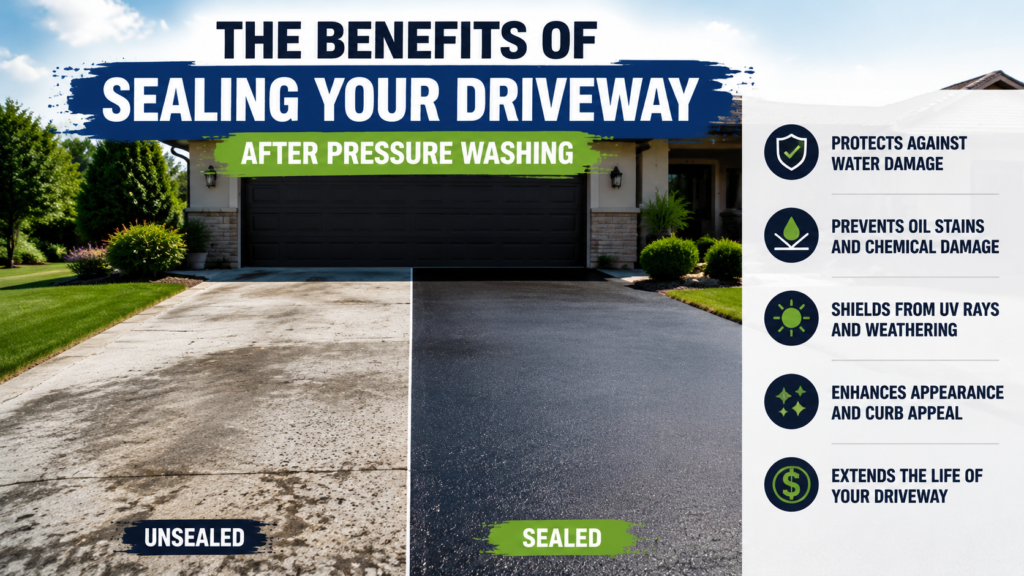
Reducing how much water is absorbed into the surface is one of the biggest advantages of sealing. This matters most during the colder months, when trapped moisture can freeze, expand and place additional strain on paving materials. A sealed driveway is far better placed to cope with this seasonal cycle than one left bare.
Slower Algae and Moss Regrowth
One of the most common frustrations homeowners raise after a clean is how quickly moss and algae seem to reappear. Sealing will not stop this forever, but it does make the surface a much less welcoming environment for spores and organic matter to take hold, which means the driveway stays presentable for considerably longer between cleans.
Easier Ongoing Maintenance
Dirt and debris struggle to embed themselves into a sealed surface the way they can with an untreated one, so day to day sweeping and the odd rinse down tend to keep the driveway looking sharp with far less effort.
Stronger Resistance to Staining
Oil drips, fuel spills, tyre marks and general vehicle residue are a fact of life on most UK driveways. A sealed surface gives these substances far less opportunity to soak in, which makes them considerably easier to lift before they leave a permanent mark. This is particularly useful for households running more than one vehicle.
Colour and Texture Enhancement
Sealing does not just protect, it also enhances. Many sealants deepen and enrich the natural colours of block paving and stone, restoring some of the vibrancy that fades over time and improving the overall uniformity of the surface. On block paving especially, the difference in depth of colour can be striking.
Support for Joint Stability on Block Paving
Pressure washing can dislodge some of the kiln dried sand from the joints between blocks. Once the surface has dried, resanding and then sealing helps lock that sand back in place, which supports the structure of the paving, reduces the chance of weeds establishing themselves, and helps prevent individual blocks from shifting over time.
A Genuine Reduction in Weed Growth
Weeds rarely grow through solid block itself. They usually take hold in accumulated debris and jointing material once wind blown seeds settle into the gaps. By stabilising the joints and reducing how much organic matter and moisture can gather there, sealing makes it considerably harder for weeds to establish a foothold.
Why UK Weather Makes Sealing Especially Worthwhile
The British climate is uniquely demanding on outdoor surfaces. Frequent rainfall keeps driveways damp for extended stretches, particularly through autumn and winter, and that persistent moisture is exactly what algae, moss and lichen need to thrive. Add in periods of frost, and any water that has soaked into an unsealed surface can freeze, expand and contribute to long term structural wear.
Shaded driveways and those close to trees are especially prone to this cycle, since they rarely get the chance to dry out fully between spells of wet weather. A quality sealant addresses this directly by reducing water absorption and giving the surface a genuine head start against the conditions it faces for most of the year.
Is Sealing Right for Every Driveway?
Sealing tends to deliver the clearest benefit on block paving, concrete and natural stone, which is where the vast majority of UK driveways fall. Imprinted or patterned concrete in particular benefits from sealing, since the decorative surface layer is prone to fading under sunlight and traffic, and a sealant helps preserve that pattern and colour for years longer.
Resin bound driveways are a different case. Many are engineered to perform without additional sealing, and manufacturers often advise against applying a product that was never part of the original system. The same is generally true of tarmac in good condition, where a sound surface often does not need sealing at all.
It is also worth being honest about surfaces that are already cracked, crumbling or past their working life. No sealant will rescue a driveway in that condition, and any repairs should be addressed first. This is exactly the kind of assessment a professional will make before recommending sealing, rather than applying it as a blanket upsell regardless of what the surface actually needs.
Getting the Timing Right
Sealing should never be rushed. The driveway needs to be thoroughly cleaned, fully dry, and free of any trapped moisture before a sealant is applied. Sealing a surface too early, or over ground that has not been properly treated for moss and algae, can trap dampness underneath the coating. That tends to result in a cloudy, patchy finish, and in worse cases, growth can develop beneath the seal where it cannot be reached or treated.
Professional installers monitor conditions such as surface moisture, air temperature and the weather forecast before going ahead, which is one of the main reasons DIY sealing so often falls short of expectations. Applying too much or too little product, sealing over a damp surface, or using the wrong type of sealant for the material can all affect the finished result.
Signs Your Driveway Could Benefit From Sealing
It is often worth considering sealing if you notice any of the following on your driveway:
- Algae or moss returning quickly after cleaning
- Water soaking straight into the surface rather than beading on top
- Fading or dulling colour compared to when it was first laid
- Frequent staining that is becoming harder to shift
- Sand loss or gaps appearing between paving blocks
- A general need for more frequent cleaning than in previous years
If several of these sound familiar, it is a strong indication that the surface is currently unprotected and would benefit from a proper seal.
Keeping Kerb Appeal All Year Round
Unlike a garden that changes with the seasons, a driveway is on show every single day, whatever the weather. It is also usually the first thing a visitor, neighbour or potential buyer sees when they approach a property, which makes its condition a significant factor in overall kerb appeal.
A driveway that has been properly cleaned and sealed tends to stay brighter for longer, resists staining more effectively, and holds up far better against the weather than one that has simply been washed and left. For anyone preparing to sell their home, or who simply takes pride in how their property looks, that lasting presentation makes a genuine difference.
Getting Professional Cleaning and Sealing Right
Sealing is most effective when it is treated as part of a complete process rather than a rushed final step. That means a thorough clean, the right treatment for any moss or algae, proper drying time, and a sealant chosen to suit the specific material, whether that is block paving, concrete or natural stone.
At Platinum Exterior Cleaning, we combine expert driveway and block paving cleaning with careful preparation to make sure any sealing work goes on to a surface that is genuinely ready for it. The same attention applies across our other services too, including patio cleaning, roof cleaning and gutter and fascia cleaning, so every part of your property gets the same standard of care.
If your driveway in Bournemouth, Poole, Christchurch or Ringwood is due a clean, or you are unsure whether sealing is the right next step for your surface, get in touch with our team for honest, straightforward advice. You can also browse our blog for more tips on keeping every part of your property looking its best throughout the year.
Frequently Asked Questions
Can I seal my driveway myself after pressure washing it?
You can, but getting the timing, drying conditions and product choice right is harder than it looks. Sealing over a damp surface or using the wrong sealant for your material can trap moisture underneath and lead to a patchy, uneven finish, so professional application generally delivers a far more reliable and longer lasting result.
How long does a driveway need to dry before sealing?
This depends on the weather and the material, but the surface must be completely dry with no trapped moisture before any sealant goes on. Professional installers assess conditions such as temperature and humidity rather than working to a fixed number of hours.
Does sealing stop moss and algae completely?
No sealant can prevent organic growth forever, but a good one significantly slows it down by making the surface a far less hospitable place for spores to settle, which keeps the driveway looking cleaner for much longer between cleans.
Do all driveway materials need sealing?
Not necessarily. Block paving, concrete and natural stone generally benefit the most. Resin bound driveways and tarmac in good condition are often designed to perform well without sealing, so it is worth getting a professional opinion before assuming sealing is required.
How often should a sealed driveway be resealed?
This varies depending on the product used, traffic levels and weather exposure, but most sealed driveways benefit from reassessment every couple of years. Signs that resealing is due include water soaking in rather than beading, faster dirt build up, and a noticeable dulling of colour.
If you are exploring sealing options for a surface we are not yet familiar with, our team is happy to talk through your driveway and recommend the right approach for its material and condition.