
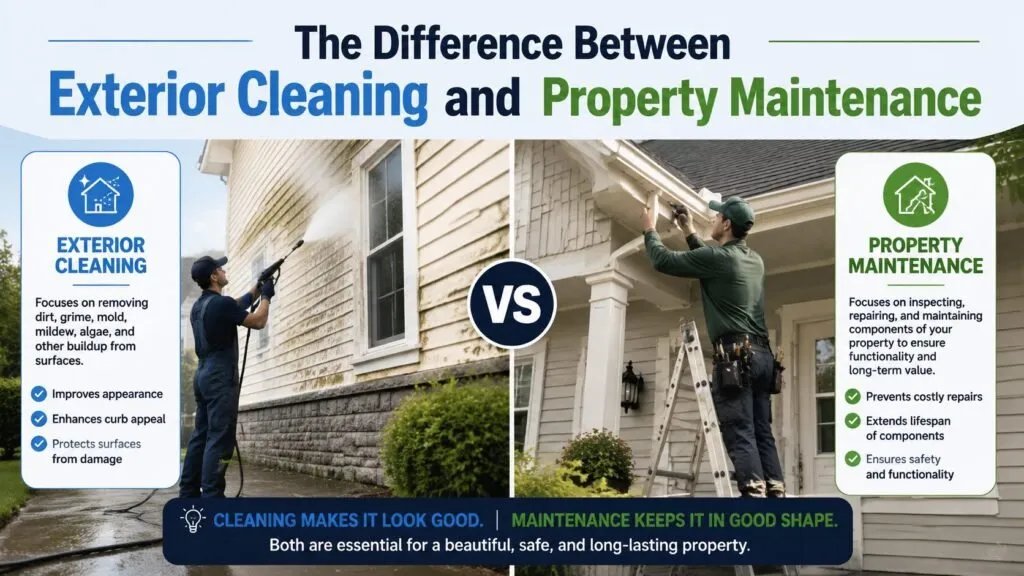
Most homeowners use “exterior cleaning” and “property maintenance” as if they mean the same thing. They don’t. And the gap between them is exactly where small problems quietly turn into expensive ones.
A clean driveway feels like a job well done. A bright, moss-free roof looks brilliant from the kerb. But a property that looks clean isn’t always a property that’s been maintained and understanding that distinction is the difference between spending £200 every couple of years and facing a £5,000 repair bill you never saw coming.
At Platinum Exterior Cleaning, we’ve spent years working on homes across Bournemouth, Poole, Christchurch, and Ringwood, and we’ve seen first-hand how blurring these two ideas costs property owners money. This guide breaks down what each one really means, where they overlap, where they don’t, and how to know which one your property actually needs.
What Exterior Cleaning Actually Means
Exterior cleaning is the process of removing visible contaminants dirt, algae, moss, lichen, oil stains, biofilm, pollution, bird droppings, and organic growth from the outside surfaces of a property. It’s the surface-level reset.
It typically covers:
- Roof tiles and slates
- Render, brickwork, and cladding
- Driveways and block paving
- Patios and decking
- Gutters, fascias, and soffits
- Windows, conservatory roofs, and UPVC
The aim of cleaning is immediate visual restoration. You can see the difference the moment the work is done. A black-streaked roof becomes uniform again. A green patio becomes safe to walk on. A grimy fascia goes back to white.
Cleaning gives relief. It solves the problem you can see right now.
What Property Maintenance Actually Means
Maintenance is broader, slower, and far less satisfying in the short term. It’s the ongoing process of keeping a property functioning as it was designed to protect the structure, the materials, and the systems that keep water, heat, and air moving the way they should.
Property maintenance includes things like:
- Keeping rainwater flowing through gutters and downpipes
- Preventing moss and algae from regrowing on roofs and renders
- Sealing driveways and re-sanding block paving joints
- Inspecting fascias, soffits, and seals for damage
- Spotting early signs of damp, movement, or material breakdown
- Re-oiling timber decking before it splinters or warps
Maintenance isn’t about how a surface looks today. It’s about how that surface will perform in three, five, or ten years. It works on what you can’t see moisture under tiles, weakening jointing sand, flexing fascia boards, water finding paths it shouldn’t.
Why Most Services Blur the Line (And Why It Matters)
Here’s the uncomfortable truth: most exterior cleaning companies sell cleaning, but they market it as maintenance. The reason is simple cleaning is easier to sell. The customer can see the result. They feel like they got their money’s worth. The before-and-after photos look great on social media.
Maintenance is harder to sell because the result is often invisible. Nothing dramatic happens. The roof just keeps doing what it should. The gutters just keep draining. The driveway just keeps holding its joints. There’s nothing to photograph.
So services drift toward the visual win. They blast a patio that didn’t need pressure. They clean the same roof every two years without ever applying a biocide that would slow the regrowth. They pressure-wash render that should have been soft-washed. The property looks great for six months — then the same problem returns, sometimes worse, because the underlying conditions were never addressed.
This is the difference between chasing symptoms and solving causes.
Cleaning vs Maintenance: A Side-by-Side Comparison
| Aspect | Exterior Cleaning | Property Maintenance |
| Primary goal | Remove visible dirt and growth | Prevent long-term damage |
| Timeframe | Immediate result | Ongoing protection |
| What it addresses | Symptoms (stains, algae, blockages) | Causes (drainage, moisture, wear) |
| Visibility of benefit | Obvious before-and-after | Often invisible until something fails |
| Frequency | Periodic (12–36 months) | Continuous awareness, scheduled checks |
| Cost pattern | Per-job, surface-based | Spread, preventative |
| Risk if skipped | Property looks dirty | Property degrades structurally |
| Best example | Pressure washing a driveway | Re-sanding joints and applying sealant after washing |
Both matter. Neither replaces the other. The mistake is treating them as interchangeable.
Where Cleaning Becomes Maintenance And Where It Doesn’t
Some exterior cleaning tasks naturally cross into maintenance territory. Others don’t. Knowing the difference helps you spend wisely.
Cleaning that is maintenance
- Gutter clearing. Clearing leaves and silt isn’t cosmetic; it directly prevents overflow, damp walls, and foundation issues. This is maintenance dressed as cleaning. Our gutter and fascia cleaning service is designed around this principle.
- Roof biocide treatment. Killing the spores that produce moss and algae before they regrow extends the life of your tiles. Cleaning a roof without treatment is half the job.
- Soft-washing render. Done properly, this removes growth without forcing water into the substrate, and it usually involves a residual treatment that prevents quick return.
Cleaning that’s just cleaning
- Pressure washing a driveway purely for appearance, with no re-sanding or sealing afterwards.
- Blasting a patio to make it green-free for a barbecue, then ignoring the shaded area where it always returns first.
- Cleaning fascias for a viewing while the gutter behind them is still blocked.
The first list adds years to your property. The second list resets the clock and then the clock starts ticking again immediately.
Rooflines Tell the Truth Faster Than Anywhere Else
If you want to know whether a property is genuinely being maintained or just superficially cleaned, look up.
Roofs, gutters, fascias, and soffits are the parts of a building that deal with water, the single biggest threat to any property in the UK climate. When something is wrong with how water flows off a building, the symptoms show up fast: streaking down render, overflow staining on brickwork, algae lines under joints, damp patches at the top of internal walls.
These aren’t cosmetic issues. They’re warnings. And they’re the reason roof cleaning and gutter clearing should never be treated as occasional spruce-ups. They are foundational maintenance tasks. The property below them depends on them working.
Most homeowners only think about gutters once they’re visibly blocked or overflowing. By that point, water has usually already been running where it shouldn’t for months. Cleaning at that stage isn’t prevention it’s damage control.
Why Pressure Isn’t the Same as Progress
There’s a widespread assumption that exterior cleaning is mostly about water pressure: more pressure equals better results. Anyone who’s been doing this work properly knows that’s almost never true.
High pressure has a place. On heavily soiled concrete, on solid hard surfaces, on certain stained driveways, controlled high pressure is exactly the right tool. But used carelessly, it does real damage:
- Strips jointing sand from block paving
- Roughens stone and concrete, making them more prone to dirt retention
- Forces water under tiles, behind render, and into mortar joints
- Damages soft timber decking and timber fascia boards
- Removes the surface layer of softer stones, exposing more porous material underneath
This is why our approach for delicate surfaces like roofs, render, and timber uses soft washing: low-pressure application of biodegradable detergents that break down growth chemically rather than mechanically. The surface is respected. The cleaning lasts longer. The next clean is needed less often.
When someone tells you they “blasted” your patio every year, they’re describing repeated short-term resets not maintenance.
The Real Cost of Neglect: A 5-Year Comparison
The financial argument for treating exterior care as maintenance, not just cleaning, is strongest when you look at what each path actually costs over time.
| Scenario | 5-Year Spend | Likely Outcome |
| No cleaning or maintenance | £0 | Moss-damaged tiles, blocked gutters causing damp, faded render repair bills often £5,000–£12,000 |
| Reactive cleaning only (clean when visibly dirty, no treatments) | £600–£1,200 | Surfaces look clean briefly but degrade between cleans; repairs likely within 5–7 years |
| Maintenance-led cleaning (planned cleans + biocide + sealing + gutter checks) | £1,500–£2,500 | Surfaces stay protected, materials last longer, no major repairs typically required |
The maintenance-led approach costs more upfront across five years. It saves significantly more across ten. The homeowners who spend the least overall are almost always the ones who started spending sensibly early.
How to Tell Whether You Need Cleaning or Maintenance
A useful way to think about it: if you can see the problem, you probably need cleaning. If you suspect the problem, you probably need maintenance.
Signs you need exterior cleaning
- Visible green or black staining on roof, render, or paths
- Slippery patio or decking
- Overflowing or visibly blocked gutters
- Oil stains, weed growth, or moss in driveway joints
- Discoloured fascias and soffits
Signs you need a maintenance review
- It’s been more than two years since anything was checked
- You’ve recently had repeat issues in the same area (e.g. moss returning quickly)
- You’re noticing damp patches inside that align with external walls
- The property is shaded, surrounded by trees, or near the coast
- You’re planning to sell within the next 12–24 months
The second list is where most homeowners under-invest, because nothing on it screams for attention. But it’s where the savings are.
Bournemouth, Poole, Christchurch and Ringwood: Why Local Climate Matters
The South Coast climate is uniquely tough on exterior surfaces. Salt-laden air from the Channel, frequent rainfall, mild winters that allow algae to thrive nearly year-round, and tree-heavy suburbs all combine to accelerate the build-up of organic growth on roofs, render, and paving.
This is why a one-size-fits-all cleaning schedule rarely works locally. A property in Christchurch surrounded by mature trees needs more frequent gutter and roof attention than an exposed coastal property in Bournemouth, but the coastal property might need more frequent UPVC and window care due to salt residue.
A maintenance-led service plans around these realities. A cleaning-only service tends to ignore them.
Our patios and decking cleaning and driveway and block paving cleaning services are scheduled and specified based on the surface, the surroundings, and the local conditions — not a generic calendar.
Recommended Maintenance Frequencies for UK Properties
| Area | Recommended Frequency | Notes |
| Roof | Clean every 2–3 years; biocide every 12–18 months | More frequent if shaded or near trees |
| Gutters | Twice per year minimum | Critical after autumn leaf fall |
| Driveway | Annually; reseal every 2–3 years | Block paving needs re-sanding after each clean |
| Patio / Decking | Annually | Decking should be re-oiled after cleaning |
| Render | Every 2–4 years | Soft wash only, with biocide treatment |
| Fascias & Soffits | Annually | Often combined with gutter clean |
| Conservatory Roof | Every 12–18 months | Algae build-up affects light transmission |
These are guidelines, not rules. A surveyor’s eye is more valuable than a calendar.
What an Experienced Cleaner Does Differently
The visible difference between a cleaning-focused operator and a maintenance-focused one is small. The long-term difference is huge.
A maintenance-thinking cleaner will:
- Clean rooflines before walls, so water washes downward, not upward into already-clean surfaces
- Reduce pressure on damaged or aged surfaces rather than forcing them through aggressive cleaning
- Watch where the water goes after rain to identify drainage problems before they cause staining
- Apply biocides and sealants as a normal part of the job, not an upsell
- Refuse work that would do more harm than good, for example, pressure-washing a render that’s already failing
- Explain why a problem is recurring rather than just removing the latest layer of it
This is the difference between someone who shows up with a pressure washer and someone who shows up with a plan.
Cleaning Shows Effort. Maintenance Shows Care.
Cleaning removes what’s there. Maintenance protects what’s underneath. They are not interchangeable, and the homeowners who understand the distinction are the ones whose properties hold their value, look better for longer, and cost the least to keep that way.
The best exterior care doesn’t aim to make your property look new every couple of years. It aims to make sure your property never has to be made new again.
Get a Maintenance-Led Exterior Service in Bournemouth, Poole, Christchurch & Ringwood
If you’ve been treating exterior cleaning as a one-off cosmetic refresh, you’re not alone, most homeowners do. But the gap between cleaning and proper maintenance is where the real savings, and the real damage, both live.
At Platinum Exterior Cleaning, we approach every job with both lenses: clean what needs cleaning, but always with an eye on what’s actually going to keep the property protected. Whether it’s a one-off roof clean, a structured annual schedule, or a full review of every external surface on your home, we’ll tell you honestly what needs doing now, what can wait, and what’s just cosmetic.
Contact us today for a free, no-obligation quote or call 07734 928740 to speak to our team about your property.
Frequently Asked Questions
Is exterior cleaning the same as property maintenance?
No. Exterior cleaning removes visible dirt, algae, and moss from surfaces. Property maintenance is the broader, ongoing work of keeping a property’s materials and systems performing as they should, including drainage, sealing, biocidal treatments, and inspection. Cleaning is part of maintenance, but maintenance is much more than cleaning.
How often should exterior cleaning be done as part of a maintenance plan?
Most properties benefit from a roof clean every 2–3 years, gutter clearing twice a year, an annual driveway and patio clean, and render cleaning every 2–4 years. Properties near trees, on the coast, or in shaded positions usually need more frequent attention.
Can pressure washing damage my property?
Yes, when used incorrectly. Excessive pressure can strip jointing sand from block paving, damage render, force water under roof tiles, and roughen stone surfaces. A proper exterior cleaner adjusts pressure and uses soft washing where appropriate.
Will cleaning my roof actually extend its life?
Only if it’s done correctly and includes a biocide treatment. Cleaning alone removes visible growth, but the spores remain meaning regrowth is fast. A maintenance-led roof clean kills the source, slowing the cycle and protecting the tiles.
Is exterior cleaning worth it before selling a property?
Yes, significantly. UK estate agents widely report that a clean, well-maintained exterior can increase perceived value by 3–5% and speed up sale times. Buyers read a clean exterior as a sign that the rest of the property has been looked after.