
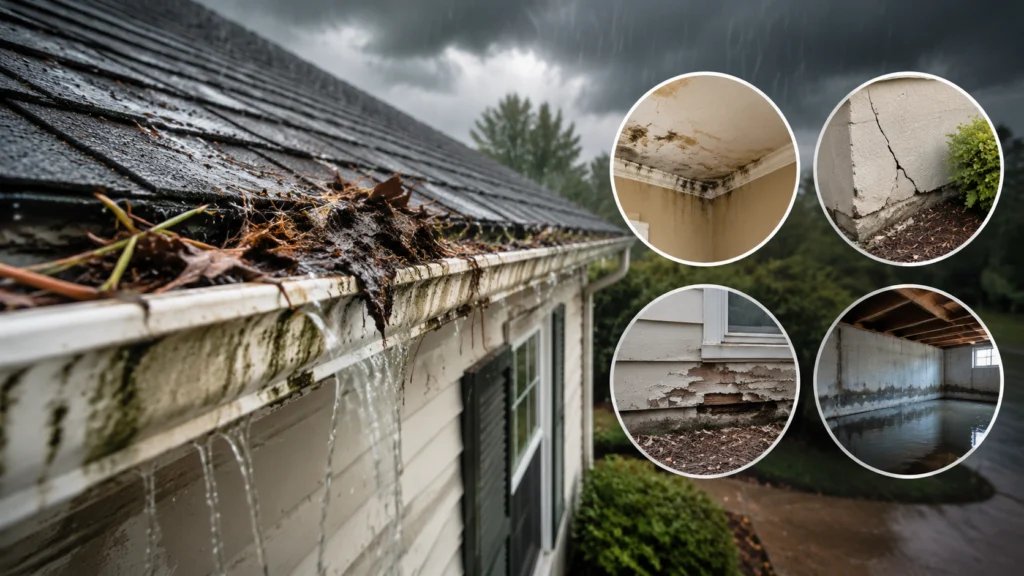
Gutters are one of the most underappreciated parts of any home. Tucked away along the roofline, they quietly do one of the most important jobs in property maintenance: directing rainwater away from your walls, roof, and foundations. But when gutters are ignored, that quiet protection disappears, and a slow chain of damage begins.
For homeowners in Bournemouth, Poole, Christchurch, and Ringwood, the UK’s damp climate makes this even more critical. Frequent rainfall, autumn leaf fall, and the year-round growth of moss mean that gutters here face more pressure than in drier parts of the country. Understanding what happens when gutter cleaning is neglected is the first step towards protecting your home.
At Platinum Exterior Cleaning, we have seen first-hand how preventable problems escalate when gutters are left unattended. This guide walks through every consequence in detail so you know exactly what is at stake.
What Do Gutters Actually Do?
Before exploring the risks of neglect, it helps to understand what gutters are designed to achieve.
Your gutter system collects rainwater from the roof and channels it through downpipes, safely routing it away from the property into a drain or soakaway. Without functioning gutters, rainwater would fall directly from the roofline and land right beside the base of your walls and foundations, day after day.
When gutters work properly, they protect your roof structure, fascia boards, external walls, cavity insulation, window frames, foundations, driveway, and garden. When gutters become blocked, every single one of those areas becomes vulnerable.
What Causes Gutters to Block?
Gutters do not need to be neglected for years before they block. In areas with overhanging trees, a single autumn season can fill a gutter with leaves. The most common causes of blockage include fallen leaves and twigs, moss and algae growing from the roof, bird nests and feathers, silt and dirt washed in by rainfall, and shingle grit shed from roof tiles.
In the UK’s mild and damp climate, moss growth is particularly aggressive. It spreads from the roof surface into the gutters, forming thick, spongy mats that trap moisture and accelerate the blockage process. Once moss establishes itself in a gutter, it creates a self-reinforcing problem: it holds water, which encourages more growth, which attracts more debris.
The Immediate Signs That Gutters Need Cleaning
Many homeowners do not realise their gutters are blocked until visible damage has already begun. However, there are warning signs that can alert you early:
Water spilling over the edge of gutters during rainfall is the clearest indicator of a blockage. Sagging or uneven gutter lines suggest the weight of debris and stagnant water is bending or breaking brackets. Green or black staining along external walls below the gutterline shows that water is regularly overflowing and saturating the brickwork. Moss or even plants visibly sprouting from the gutters confirm prolonged neglect. Damp patches on internal ceilings or upper walls indicate that overflow water has already begun penetrating the structure. Rust spots or cracked joints in older systems suggest the gutters themselves are beginning to fail.
Roof Damage: The First Structure at Risk
The roof is the first structure to suffer when gutters stop functioning. When a gutter fills with debris and water cannot drain away, it overflows backwards towards the roofline. This water begins to sit against the timber fascia boards and soffit panels, saturating the wood and encouraging rot.
In winter, water trapped in and around gutters freezes and expands. This puts enormous pressure on gutter joints and the tiles or slates at the roofline, causing cracks and splits that allow water to get beneath the roof covering. Once water passes beneath tiles or slates, it reaches the timber battens underneath, and rot begins.
Left unresolved, roof rot spreads quickly. What starts as a small soft patch in a batten can progress to failing structural timbers, interior leaks, mould in the loft, and eventually the need for major roof repairs or full replacement. Our professional roof cleaning service removes moss and debris from the roof surface before it migrates into the gutters, providing an important first line of defence.
Fascia and Soffit Damage: The Hidden Casualty
The fascia boards and soffits that run along the roofline are particularly vulnerable to gutter overflow. These surfaces are directly below the gutters and receive the brunt of any overflow.
Fascia boards made from timber absorb water rapidly when wet. Once saturated repeatedly, the wood begins to soften, crack, and rot. Replacing rotten fascia boards is a significant job that usually requires scaffolding access and comes with considerable disruption.
What makes fascia damage especially insidious is its connection to roof ventilation. Modern soffits are ventilated to allow airflow into the roof space, which prevents condensation and mould forming in loft insulation. When gutters overflow repeatedly, that overflow water runs directly across the soffits, soaking the ventilation holes and blocking airflow. Once ventilation is disrupted, condensation builds up inside the attic, and both the insulation and the structural timbers above it begin to suffer.
Damp Penetration: When Water Gets Into Your Walls
One of the most damaging consequences of blocked gutters is what happens to the external walls below the overflow point. As water repeatedly spills over the edge of a blocked gutter, it runs down the face of the wall. Brickwork and render are not designed to handle this level of sustained water contact.
Over time, the constant wetting and drying cycle draws moisture deeper into the wall. Mortar joints begin to deteriorate. Water reaches the cavity insulation and saturates it. Once insulation becomes waterlogged, its effectiveness drops dramatically, and heat loss from that wall increases significantly. The knock-on effect is higher energy consumption as your heating system works harder to compensate.
Mould and Health Risks
Persistent moisture in walls and loft spaces creates the ideal conditions for mould growth. Mould is not merely a visual problem. It releases microscopic spores into the air throughout the property, and those spores carry genuine health risks, particularly for children, the elderly, and anyone with respiratory conditions.
Prolonged exposure to mould spores has been linked to worsening asthma symptoms, chronic respiratory infections, allergic reactions, fatigue, and in serious cases involving toxic black mould, neurological effects. The NHS has long recognised damp and mould in homes as a significant public health concern.
Treating established mould inside a property requires specialist remediation, replastering, and in some cases replacing contaminated insulation. Preventing gutter overflow is far simpler than dealing with the health and structural consequences that mould brings with it.
Foundation and Ground-Level Damage
When gutters overflow consistently, the water that runs down the walls reaches the ground and begins to saturate the soil around the base of the property. This is where the consequences become most serious in structural terms.
Soil around building foundations needs to remain stable to support the weight of the building. When soil repeatedly becomes saturated, it expands. When it dries, it contracts. This cycle of expansion and contraction exerts lateral pressure on foundation walls and can cause cracking in the masonry. In older properties with shallower foundations, this cycle can lead to subsidence, a condition where the ground beneath the building shifts or sinks.
Ground-level overflow water also affects driveways and paths. Where overflow water consistently lands on block paving or stone paths, it encourages algae and moss growth on those surfaces, creating slipping hazards. Our driveway and block paving cleaning and patio and decking cleaning services can restore these surfaces, but addressing the source of the overflow is always the essential first step.
Pest Infestations: Uninvited Residents
Blocked gutters become attractive habitats for a range of pests. Stagnant water is a breeding ground for mosquitoes and midges during warmer months. Birds are drawn to gutters filled with wet debris as nesting material, and their nests can block downpipes completely. Mice and rats may access roof spaces via damaged fascia boards weakened by moisture.
Wasps frequently build nests in the cavities behind damp or rotting fascia boards, and wood-boring insects such as woodworm are attracted to soft, damp timber. Once pests have established themselves in a roof or wall cavity, clearing them requires professional pest control and is often followed by repair work to seal their entry points.
The Impact on Neighbouring Properties
For those living in terraced or semi-detached houses, blocked gutters can create friction with neighbours. When water overflows consistently from one property, it can run along shared walls and cause damp penetration into the adjoining home. Disputes over water damage between neighbours can become complex, involving surveyors and, in some cases, legal correspondence. Maintaining clean gutters is not only about protecting your own home but also about being a considerate neighbour.
Kerb Appeal and Property Value
The visual impact of neglected gutters is often underestimated. Overflowing water leaves dark streaks of algae, mould, and mineral deposits on walls and fascia boards. These stains develop gradually and, over time, give a property a noticeably neglected appearance.
When the time comes to sell a property, surveyors and buyers pay close attention to the condition of the guttering system. Overflow marks, sagging sections, and visible damp staining are interpreted as evidence of poor overall maintenance. They raise concerns about what other maintenance may have been deferred, and they frequently result in downward pressure on the agreed sale price or requests for repairs before exchange.
Clean, properly functioning gutters, by contrast, signal a well-maintained home and contribute positively to the overall impression a property makes.
The Seasonal Cycle of Gutter Neglect
In the UK, gutters go through a predictable cycle of stress throughout the year that accelerates damage when they are not maintained.
During spring, seeds, pollen, and the remnants of winter debris create a fertile mix that encourages rapid moss and weed growth inside gutters. Summer sees dried debris harden into a compact mass that is resistant to rain and narrows the channel significantly. Autumn brings the heaviest leaf fall of the year, and heavy rainfall during this period overwhelms already partially blocked gutters, causing the most dramatic overflow events. Winter is when the consequences become physical: freezing temperatures cause water trapped in debris to expand, cracking plastic joints, splitting seals, and forcing apart sections that were previously sound.
A single winter with uncleared gutters can cause visible structural damage to an otherwise well-maintained system.
How Often Should Gutters Be Cleaned?
For most UK homes, gutters should be cleared professionally at least twice per year. The ideal schedule is a spring clean to remove the debris accumulated over winter and to inspect for any freeze damage, and an autumn clean before the heaviest leaf fall arrives and before temperatures drop.
Properties with many surrounding trees, or those in particularly sheltered or shaded positions that encourage moss growth, may benefit from more frequent attention. After major storms it is also worth visually checking downpipes and gutter sections for displaced debris or dislodged brackets.
Why Professional Gutter Cleaning Matters
Clearing gutters from a ladder is something some homeowners attempt themselves, but there are good reasons why professional cleaning offers significantly better results.
Professionals use high-reach pole systems that access all parts of the gutter safely from ground level, including sections over porches, extensions, and conservatories that are difficult to reach with a standard ladder. A thorough professional clean includes flushing the system with water to test flow through downpipes and identify any hidden blockages or leaks that are not obvious from visual inspection alone.
Working at height on a ladder carries real risk, particularly on older or uneven ground, and particularly when trying to work with one hand while holding the ladder with the other. A professional team works safely, efficiently, and with insurance in place for any unexpected events.
At Platinum Exterior Cleaning, our gutter and fascia cleaning service covers everything from removing debris and flushing downpipes to inspecting fascia condition and identifying any early signs of damage. We serve homeowners across Bournemouth, Poole, Christchurch, Ringwood, and surrounding areas.
The Bigger Picture: Protecting Your Whole Exterior
Gutters do not exist in isolation. Their condition affects the roof above them, the fascia and soffits alongside them, the walls below them, and ultimately the foundations beneath them. A single blocked gutter is the starting point of a cascade that can touch virtually every part of a property’s structure.
The most effective approach to exterior maintenance is a joined-up one, addressing not just the gutters but also the roof surface above, the walls below, and the ground-level surfaces around the property. Our roof cleaning removes moss before it migrates into gutters. Our patio and decking cleaning restores surfaces affected by overflow water. And our driveway cleaning addresses the algae and staining that develops where water consistently contacts paved areas.
Common Misconceptions About Gutter Maintenance
A number of beliefs lead homeowners to delay cleaning longer than they should.
Some assume that plastic gutters do not need attention because they will not rot. While plastic gutters are more durable than older cast-iron systems, they still collect debris, block just as readily, and overflow with the same consequences.
Others believe that a relatively new property does not need gutter attention. In reality, new-build properties often have construction dust, mortar fragments, and shingle grit in their gutters from day one, and moss can establish itself on a new roof within a few years.
A common misconception is that overflow from gutters is visible and therefore you would notice it. Many blockages occur inside downpipes, not at the top of the gutter, meaning the overflow happens at the base of the downpipe rather than visibly over the gutter edge, and the damage builds silently over months.
Conclusion: Prevention Is Always the Wiser Path
The evidence from properties across the UK is consistent: ignoring gutter cleaning sets in motion a sequence of damage that grows progressively more serious and progressively more difficult to reverse.
What begins as a simple build-up of leaves and moss eventually becomes rotting fascia boards, damp interior walls, mould growth, foundation stress, and in the most severe cases, structural failure. Each stage of that progression is more disruptive and more involved to address than the last.
If your gutters have not been cleaned recently, or if you have noticed any of the signs described in this guide, do not wait for the damage to escalate. Contact Platinum Exterior Cleaning today for a free, no-obligation quote. Our team serves Bournemouth, Poole, Christchurch, Ringwood, and surrounding areas, and we are ready to help you protect your home before problems take hold.